
Marcel Duchamp and the Creative Act
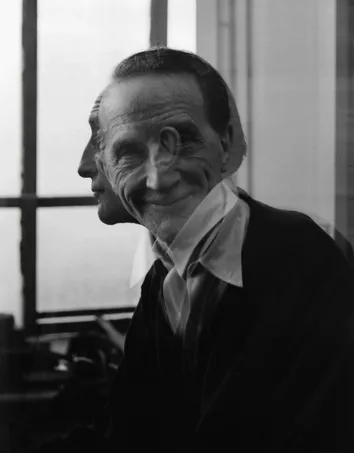
Victor Obsatz, Marcel Duchamp,1953
by Jacquelynn Baas and Paul Sharpe
Widely recognized as the most important artist of the modern era, Marcel Duchamp forever changed how art is made and understood. His groundbreaking work, and his vision of what art can be, have altered the ways in which art is presented to and experienced by the public. According to Duchamp, creativity is not the sole preserve of the makers of art; it is also enacted by those who passionately engage with art and by all of us attentively interacting with the world around us.
This book, currently in preparation, explores the ways in which Duchamp expanded our notion of creativity by envisioning art as not confined to making objects, but as a way of observing and a way of living, with every moment of life potentially a creative act. Duchamp’s goal was to democratize art by challenging traditional hierarchies and inspiring individual creativity. His steadily growing mainstream recognition has elevated the former art world renegade into a kind of hero, if a frequently misunderstood one: His iconic status has overlaid the liberating artistic message Duchamp offered with superficial rote and obfuscating scholarly interpretations.
The authors, a seasoned cultural historian with a special focus on Duchamp and an art practitioner with degrees in physics, have combined their expertise to produce a radical and playful corrective to the interpretative glut. In Marcel Duchamp and the Creative Act they create a uniquely authentic framework within which to consider Duchamp’s art of making, perceiving, and living while bringing his overarching subject – creativity – alive in the hearts of readers.
Duchamp invites us to recognize our cultural and social conventions, and to free ourselves from them. You don’t need to go to art school, he tells us; you don’t have to pick up a paintbrush or pen or musical instrument to create – all you need do is engage the world in a creative way. Duchamp invites us to play, and his subversive invitation has been undermining the seriousness of art ever since. In a world where it has become increasingly clear that no one is in charge, Marcel Duchamp can show us how to find our way, with humanity and humor.
Authors
 Jacquelynn Baas was trained as a historian of art and culture at Michigan State University (BA 1971) and the University of Michigan (PhD 1982), where she earlier was awarded a master’s degree with a specialty in museum practice. Baas worked in art museums for the first twenty-five years of her career, including the University of Michigan Museum of Art; the Hood Museum of Art, Dartmouth College (Chief Curator, Director, 1982-88); and the University of California, Berkeley Art Museum and Pacific Film Archive, where she served as Director (1988-99) and, currently, Emeritus Director.
Over the past twenty-five years, Baas has focused on curating and writing. Her most relevant book-length publications include Buddha Mind In Contemporary Art (University of California Press 2004), Smile of the Buddha: Eastern Philosophy and Western Art from Monet to Today (California 2005), and Marcel Duchamp and the Art of Life (MIT Press 2019).
 Paul Sharpe BSc (Hons), MSc, is an award-winning visual effects artist who has contributed to more than forty major motion pictures for Lucasfilm’s Industrial Light & Magic. In his over twenty years at ILM Sharpe created visual effects for more than forty movies, including the Star Wars Prequels (1999-2003), The Hulk (2003), Harry Potter (2004), Narnia (2004), Pirates of the Caribbean (2006-2007), Indiana Jones and the Crystal Skull (2008), Star Trek (2009), Rango (2011), Pacific Rim (2013), Jurassic World (2015), and Captain America (2016).
Formally educated in physics and astrophysics at University College London, San Francisco State University, and the University of California, Berkeley, his interests lie in interdisciplinary areas between art and science – in particular, modes of thinking between loose, creative thought and more rigid analysis – believing that both subjects can be made better with a mutual understanding of how they complement one another
Sharpe contributed early articles on AI for the book Bots and Other Beasties (Sams Publishing 1996). He is co-author, with Jacquelynn Baas, of the essay, “Duchamp and Infinity,” Interalia Magazine (June 2024).